


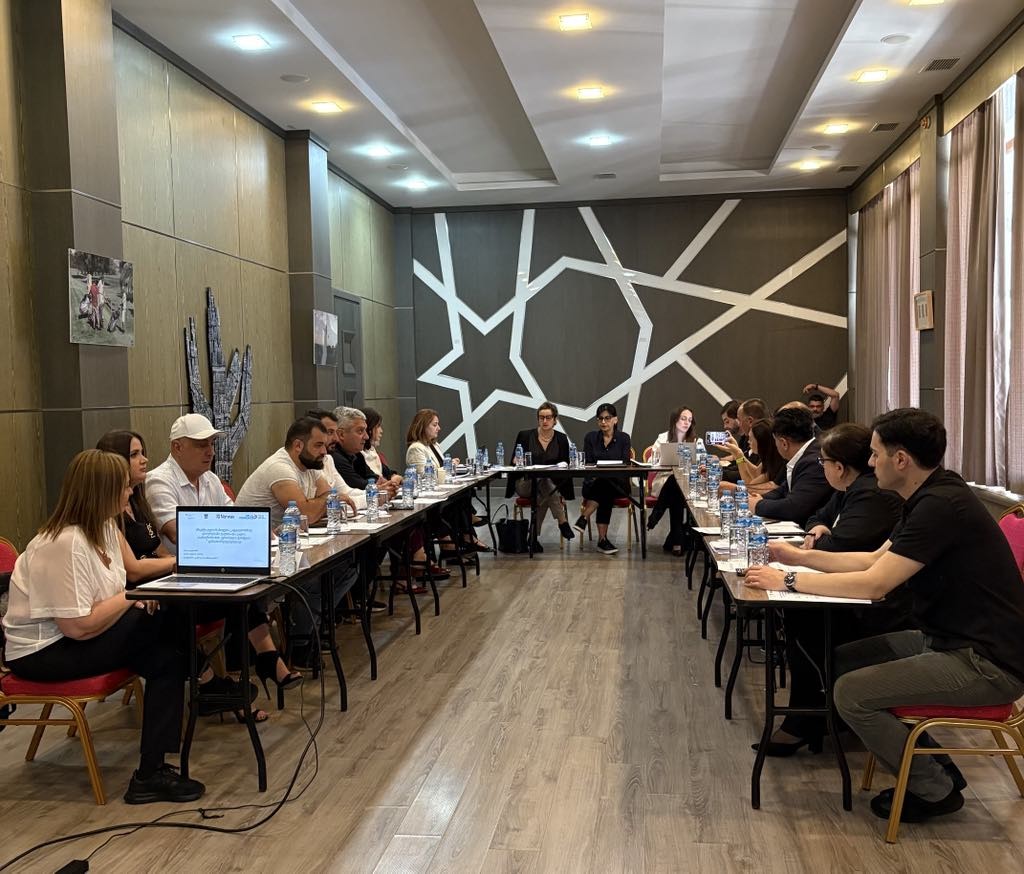
To promote the effective implementation of the Charter’s principles at the local level, the National Association of Local Authorities of Georgia (NALAG) organized a two-day training for municipalities that recently joined the European Charter for Equality of Women and Men in Local Life.
The meeting was organized within the framework of the project “Women’s Leadership for Democracy in Georgia” and involved mayors, council chairpersons, and persons responsible for gender equality from the municipalities of Dusheti, Dedoplistskaro, Dmanisi, Khashuri, and Tetritskaro.
The event was opened by NALAG Vice-President, Mayor of Dusheti Municipality, Manana (Matsatso) Narimanidze, and the Association’s Executive Director, Nino Rukhadze.
Manana (Matsatso) Narimanidze assessed the training as a space for dialogue where common visions and decisions on gender equality issues at the local level are formed. According to her, such formats not only strengthen cooperation between local governments but also promote the growth of inclusive budgeting practices and the expansion of initiatives and programs based on equality principles.
Nino Rukhadze, in her speech, once again emphasized the importance of Georgian municipalities’ involvement in the Charter. According to her, it is important that all municipalities be represented on the “Electronic Map of the Charter for Equality between Women and Men” created by CEMR, where signatory municipalities are reflected on a European scale. The NALAG leader also expressed hope that other municipalities will become interested and confirm their commitments by signing the Charter, commitments that are already being implemented in practice.
The training was led by expert Mako Avaliani, who introduced participants to the Charter’s objectives, its seven implementation stages, and thematic directions. Special attention was paid to women’s involvement in decision-making processes, reducing stereotypes and education, economic empowerment and employment promotion, access to care services, violence prevention and appropriate support mechanisms, equal access to public services, as well as gender-sensitive budgeting and data accessibility.
A significant part of the discussion was devoted to the necessity of considering the needs of vulnerable groups and practical approaches that involve integrating equality principles when planning local policies in response to climate change and crises.
The training was conducted through active group work – participants assessed their own municipalities’ needs and discussed specific steps that would contribute to the successful implementation of the Charter’s principles. Special attention was paid to assessment and monitoring mechanisms.
The event held on June 24-25 in Gurjaani Municipality was also attended by NALAG representatives – Deputy Executive Director of the Association, Lasha Archvadze, Lead Consultant of the project “Women’s Leadership for Democracy in Georgia,” Tamar Prangishvili, and project coordinators Giorgi Isakadze and Maia Abashidze.