

The pandemic is still in an active phase, and the economic crisis caused by COVID-19 has primarily affected people living in rural areas.
To address this problem, the German Society for International Cooperation (GIZ) launched a project, selecting women living in Georgian municipalities as the target audience and announced a competition to promote their economic empowerment.
The program, which was conducted under the guidance of experts invited by GIZ, including Natia Ghvinashvili, Deputy Executive Director of ATOA, National Coordinator and Expert at CEMR, and Shorena Kochlamazashvili, an expert in local economic development, provided for the purchase of necessary inventory to start a new business or expand an existing one in Senaki and Oni self-governing units. This was implemented based on a tender announced by GIZ’s contractor, the “Association of Financiers of Georgian Local Self-Government Units”.
One of the main priorities of the project was the so-called “start-up”, accordingly, the program included a masterclass on writing business projects for beneficiaries, where inexperienced women learned in detail the principles of project writing.
Within the framework of the program, special attention was also paid to projects that will contribute to reducing internal migration, creating additional jobs in municipalities, as well as developing tourism, the agricultural sector, and other areas.
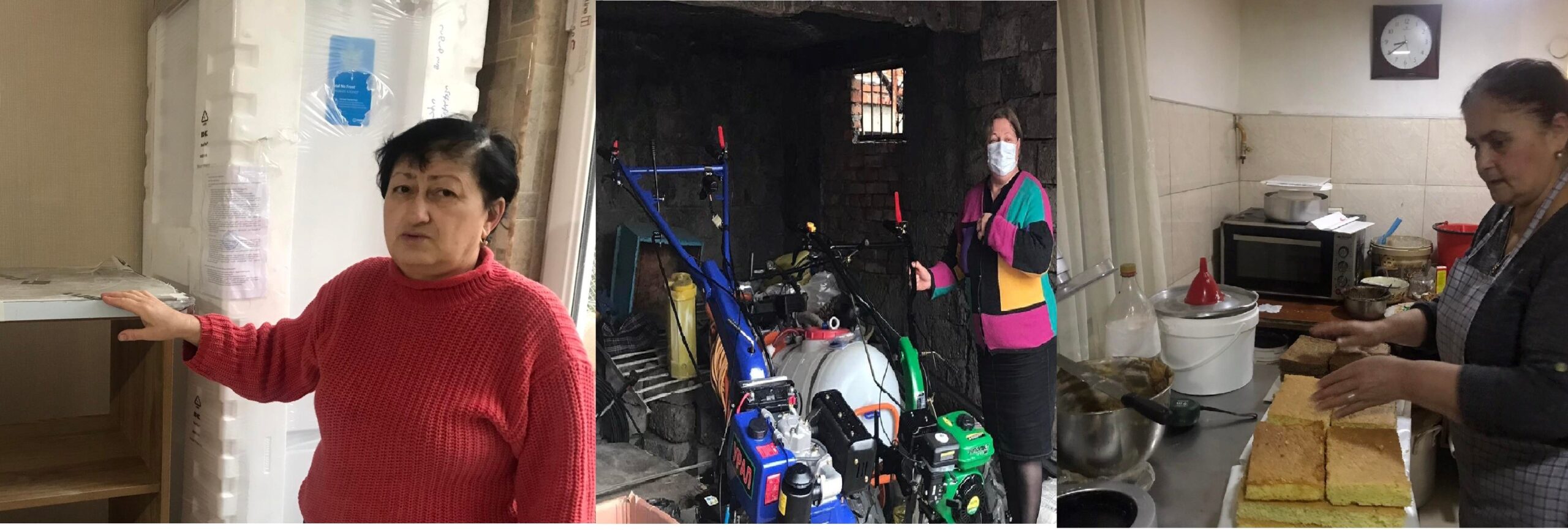
“I want to advise all women to return to their homes and do what they love in their own region. Based on my experience, I can confidently say that age doesn’t matter when it comes to implementing an idea,” says Natela Maisuradze, a native of Oni, who worked as a confectioner in Tbilisi for years.
“We are originally from Oni municipality, but my family lived in Tbilisi, and accordingly, I was employed in the capital. A few years ago, my daughter was offered a job in Oni, and I was forced to leave everything behind and participate in raising my grandchild.
When it’s difficult to find employment even in the capital, I didn’t even think about looking for a job here, and I certainly couldn’t imagine having my own income. However, at the insistent request of family members, I first delivered three cakes to the store, which sold out that same day, and then I was motivated and brought products to Ambrolauri as well as Oni. Orders gradually increased, and today I have customers from almost every village in Racha.
As you know, a local history museum is being built in Oni, which will help attract tourists, so I started thinking about expanding the business, but building a cafe requires significant resources, and I only saw the implementation of the idea in the distant future.
At the beginning of June, I read information about the German Society for International Cooperation (GIZ) program on the municipality’s social network, and today I already have all the necessary inventory and construction materials to achieve my goal,” said Natela Maisuradze. As part of the GIZ program, she received construction blocks, cement, an iron door, as well as materials for installing a showcase and metal-plastic doors and windows.
Like Natela Maisuradze, Maia Gogia lives in a historic and tourist-heavy area near the Nokalakevi Architectural Museum. Since 2001, she has been hosting guests in her own home, but due to the pandemic and tightening regulations, she saw the need to expand and began setting up a hotel for 18-20 people in a separate house on her own plot.
“The flow of tourists to our family was constant, but for the last two years, we have been very cautious due to the pandemic and have refused many vacationers. Accordingly, we decided to set up a hotel in the second house and gradually started furnishing it. As you know, renovation work and purchasing necessary inventory are associated with significant resources and time, and this process was prolonged.
When I learned about the competition of the German Society for International Cooperation (GIZ), I took a chance and submitted an application. Fortunately, my business idea was well-received. As part of the program, we received a refrigerator, kitchen furniture and a bar table, as well as wardrobes and beds. With co-financing, we purchased a washing machine, gas stove, water heater, and bathroom inventory. Now we only have to finish the yard, and I think the hotel will be able to receive guests from spring,” said Maia Gogia, a resident of Nokalakevi village in Senaki municipality.
Due to her husband’s deteriorating health, Ia Shamatava, a resident of Senaki and winner of the GIZ competition, took charge of the family business, which is involved in nursery farming.
“It’s very difficult for a woman to work with soil. With the motorized cultivator, pesticide applicator, ozone generator, and garden tool set acquired through this program, I can now confidently think not only about maintaining the business but also about expanding it. In addition to stone fruits, I can grow seed fruits, citrus crops, and subtropical persimmons,” said Ia Shamatava, noting that with the help of the project, she will be able to sell 10-15 thousand seedlings per year.
This project is implemented with the support of the German Society for International Cooperation (GIZ), as well as on behalf of the German Federal Ministry for Economic Cooperation and Development (BMZ), within the framework of the program “Good Governance for Local Development in the South Caucasus” (GGLD).

